
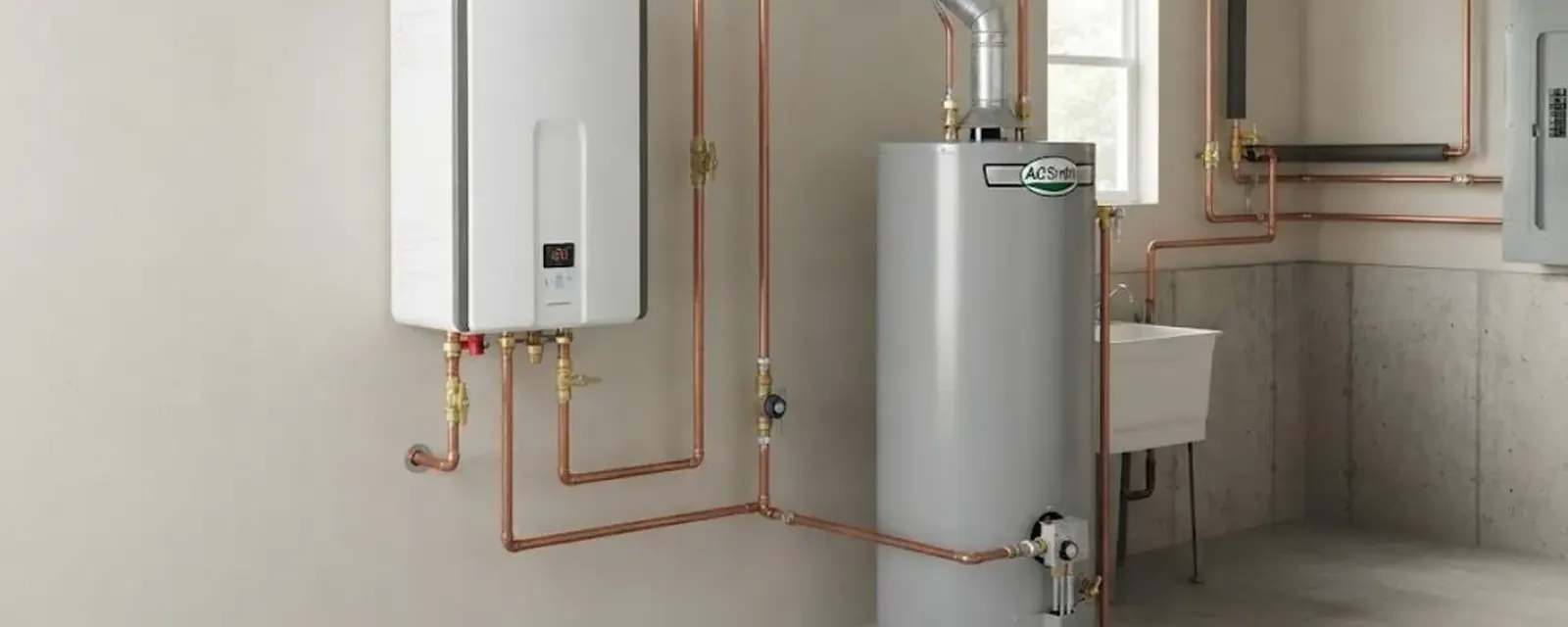
What you gain with tankless
A tankless unit heats water as it flows, so there is no stored tank to run out. That is useful in a house with a big tub, a long morning shower rush or guests. It also frees floor space and avoids standby heat loss, since there is no tank keeping water warm all day.
Units often last longer than a tank when maintained. The catch is that maintenance is not optional.
- Hot water that does not run out within the unit's flow limit.
- Smaller footprint on a wall.
- No tank to leak and flood a closet.
- No standby heat loss.
- Often a longer lifespan with a yearly flush.
The catch nobody mentions first
The biggest surprise is usually the gas line. A tankless unit fires at a much higher rate than a tank, so many houses need a larger gas line and new venting. That can double the install cost on its own. Ask for the gas line to be checked before you choose a model.
Electric tankless units avoid the gas question but can need a major electrical upgrade. Look at the amperage your panel can spare before you decide.
Scale, chloramine and Huntsville water
The City of Huntsville's 2025 report shows chloramine at an average of 3.09 mg/L and gives no hardness number. Hardness decides how fast scale builds inside a tankless heat exchanger, so test your tap or ask the utility. Hard water means more frequent descaling, and a softener may be worth pairing with the heater.
The tankless water heater page covers service and flushing, and the water softener and filtration page covers when treatment pays off.
Tankless or tank: a side-by-side
| Tankless | Tank | |
|---|---|---|
| Upfront cost | Higher | Lower. |
| Hot water supply | Continuous up to the flow limit | Limited by tank size. |
| Maintenance | Yearly flush | Yearly drain and anode check. |
| Space | Wall mounted | Floor space needed. |
| Install complexity | Gas, venting and electrical changes | Usually like for like. |
Who tankless suits and who it does not
It suits a household that will stay for years, has steady hot water use and can afford a higher install. It is a weaker choice for a rental you plan to sell soon, a small house with low use or a home where gas and venting upgrades would be heavy.
Landlords near the Sam Houston State University campus often favor a standard tank because turnover is high and tenants rarely flush a tankless unit. Our water heater installation page compares the options for a planned job.
Questions to ask before you buy
The same decisions apply in New Waverly and Riverside, although homes on propane or on well water need extra checks.
- What is the required gas line size and will the current one work.
- Where will it vent and what does that cost.
- How will the unit be flushed and who does it.
- Is a permit needed and who pulls it.
- What happens if the unit fails in the middle of the night.
A local note on permits and licensing
The City of Huntsville requires permits for new plumbing systems and states that plumbing systems must be handled by individuals licensed by the state of Texas. Ask the plumber for the Responsible Master Plumber's license number and check it with the Texas State Board of Plumbing Examiners before you sign.
Venting and gas supply for tankless units follow the International Plumbing Code (IPC) and the International Fuel Gas Code, both listed among the codes the City of Huntsville uses.
Source type: City of Huntsville permit information and Texas State Board of Plumbing Examiners
Tankless questions
Most need electricity for controls even if they burn gas, so they stop in an outage.
Often not, unless gas and venting are already in place. A standard tank is usually the better value.
If your old heater failed at night, the 24/7 line dispatches a crew. A tankless install may be scheduled after the emergency is handled.
Not always. Test your water hardness first.
Many take most of a day, longer if gas or venting must change.